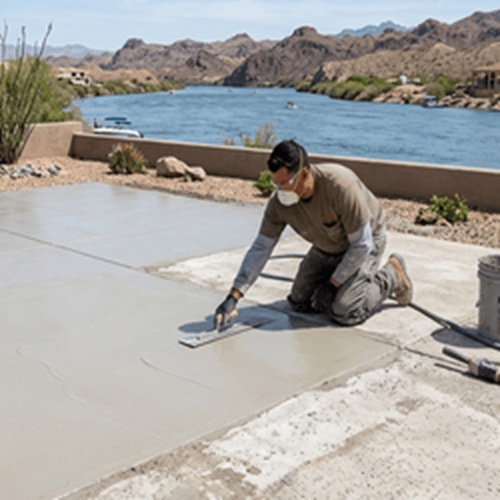
Finished Concrete Driveways: Why the Ground Determines The Length Of Time Yours Lasts
Drive around Parker, AZ long enough and you start to observe a pattern. 2 driveways of similar age sit a few blocks apart. One is limited and level with tidy joints. The various other has a spiderweb of splits near the garage, a sunken panel by the street, and edges falling apart right into the gravel. Same sun, same vehicles, exact same gales.
The distinction practically never ever comes down to the concrete itself. It comes down to what took place prior to the vehicle arrived.
Beginning with what Parker is improved
Dirt in the Parker location is not one point, and treating it as one thing is exactly how driveways fall short. Whole lots near the Colorado River through the Parker Strip, the Keys and down toward Poston, often sit on sandy, silty river-bottom deposits. That material drains pipes well yet has inadequate natural bearing toughness, and it relocates quickly when water discovers a course via it. Up on the benches and out towards Bouse and Freeway 95, you run into caliche and decomposed granite: hard, in some cases rock-hard, yet regularly unequal, with soft pockets hiding under a rigid crust.
Both conditions demand focus, for opposite factors. Loosened river sand needs to be developed into something that will bring load. Caliche requirements to be broken and reworked so a driveway isn't bridging throughout a difficult shelf on one end and soft fill on the other. Unequal support is what creates a split panel, concrete is solid in compression and weak in bending, so the moment one section loses its base, the slab bends and damages.
Compaction is the step nobody sees and everyone spends for
After excavation, an appropriate driveway obtains a granular base, typically 4 to 6 inches of accumulated base program placed in lifts and compacted, not disposed and rated flat. Raise thickness matters since a plate compactor or roller just compresses material so deep. 6 to 8 inches per lift, compressed independently, generates an uniform base. A single fourteen-inch dump compacts on top and stays loose below.
Moisture is the component that catches individuals off guard in the desert. Dirt compacts best at a specific wetness content, and in Parker's dry air, base product commonly shows up as well dry to get to density despite the amount of passes it obtains. Water needs to be included and worked in. Miss that and the base looks compacted while staying well short of the approximately 95 percent relative density that flatwork need to be improved.
This is also the stage to resolve drain. Gale tornados here go down a lot of water in a brief home window, and runoff that obtains under a slab edge will certainly search out base product period after season. Rating the subgrade to shed water and keeping watering lines and downspouts from discharging along with the driveway which secures the put for years.
Creating and putting for desert conditions
Residential driveways are frequently poured at 4 inches. In Parker, where boats, fifth wheels, plaything haulers and dually trucks are average, five to 6 inches with # 4 rebar on chairs is cash well invested, particularly in the technique apron and anywhere a trailer jack lands. Reinforcement placed in the center third of the piece does structural work; mesh laid on the ground and walked right into the mud does not.
After that there's the warmth. Pouring concrete when air temperature levels run previous 105 ° F transforms the chemistry. The mix stiffens quick, water vaporizes from the surface before the slab can bleed appropriately, and plastic contraction cracks open while the concrete is still soft. Experienced teams react by starting at dawn, maintaining the mix temperature down, withstanding need to add water on website which damages the ended up slab, and utilizing dissipation retarders and timely treating. Control joints get cut at roughly 10 to twelve feet on a four-inch piece, so contraction fractures land inside a tooled line rather than roaming throughout the center.
Treating is not optional. Concrete gains strength through hydration, moist, and a slab left to bake in 115-degree sun for a week will certainly never ever reach its made toughness.Then, and just after that, the surface
As soon as the structure is right, appearance is the very easy component. Broom surfaces give trustworthy traction. Indispensable shade, stamped stone patterns and ornamental borders turn a driveway right into part of the home's style.
Yet no surface saves a negative base. In Parker, a driveway that lasts thirty years is constructed from the subgrade up, which is why employing a commercial concrete contractor crew that understands regional soil matters greater than any item on the surface.